Stepping into the ancient city of Ephesus is an act of time travel. The air, thick with the scent of sun-drenched marble and wild herbs, whispers tales of an empire that once thrived here, its streets teeming with life, its theaters echoing with applause, and its libraries guarding the collective wisdom of the age. For those who seek more than just archaeological sites, Ephesus is a living tapestry of human stories, where every crumbling column and worn stone has a narrative to share. It is a place to walk not just through ruins, but through the legends, secrets, and spiritual echoes that defined one of the most powerful metropolises of the Roman world.
This is a journey into the soul of Ephesus, where we discover that the true splendor of the city lies not just in its architectural wonders, but in the compelling human drama etched into its very foundations.
The Celsus Library: A Legacy of Love and Hidden Desires
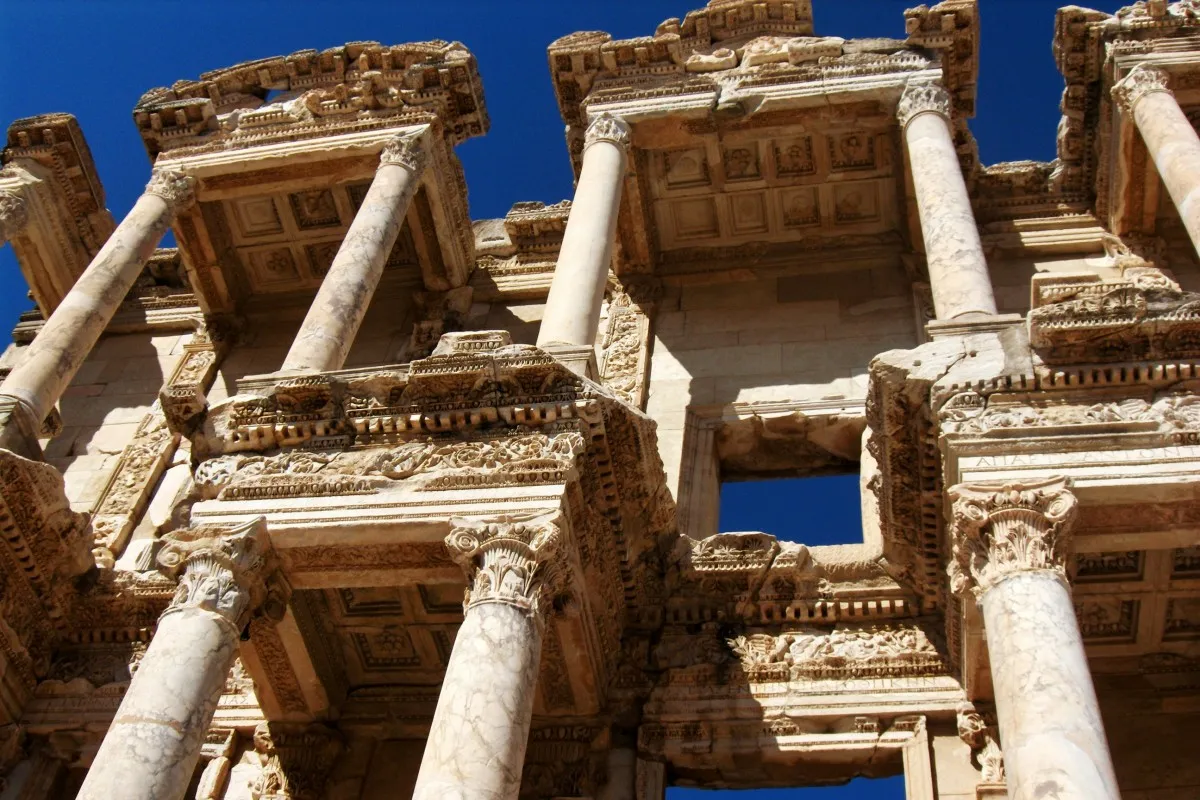
The façade of the Celsus Library is an enduring symbol of Ephesus's intellectual and architectural brilliance. But its story is far more personal than its monumental scale suggests. This magnificent structure was built as a memorial and final resting place for Tiberius Julius Celsus Polemaeanus, a former governor of the province, by his devoted son, Aquila. It was a gesture of profound respect and filial love, a testament to a man who valued knowledge and wisdom above all else. His sarcophagus was laid in a chamber beneath the central apse, placing his memory at the heart of the library’s very being, a timeless tribute that ensured his legacy would be forever linked with the pursuit of learning.
Yet, this story of honor has a mischievous, whispered counterpart. Directly across the marble-paved street from the library, a small, unassuming pathway leads to the remains of a luxurious, ancient brothel. Legend, often shared with a knowing smile, claims a secret tunnel once connected the two buildings. This supposed passage allowed prominent citizens of Ephesus to slip away from their academic pursuits at the library and into more hedonistic pleasures without public scrutiny. While this tale remains a charming piece of folklore, it paints a vivid picture of a city where the sacred and the profane coexisted, and where intellectual pursuits were not always the sole agenda. This blend of dignified history and tantalizing rumor gives the library a truly unique and human character, inviting travelers to imagine the complex lives of those who once walked its streets.
The Grandeur and Tragedy of the Temple of Artemis
Long before the Celsus Library was built, Ephesus was a global epicenter of devotion and wealth, primarily due to the magnificent Temple of Artemis, one of the Seven Wonders of the Ancient World. Its sheer scale was staggering, said to be four times the size of the Parthenon in Athens. Supported by over 127 towering columns, the temple was a beacon of unparalleled artistic and architectural achievement, attracting pilgrims and merchants from across the known world. It was not just a place of worship; it was a grand sanctuary, a bustling marketplace, and a repository of the finest sculptures and paintings of the Hellenistic period.
The temple’s glorious existence, however, was a prelude to a story of profound and tragic human folly. In 356 BC, on the very night Alexander the Great was born, a local arsonist named Herostratus set the temple ablaze. When captured and tortured, his motive was revealed to be nothing more than an insane quest for eternal fame. He craved to be remembered at any cost, even if it meant destroying something so universally revered. The Ephesians, appalled by his act, passed a decree that anyone who mentioned his name would be executed. But the tale of his desperate vanity survived, an enduring lesson on the corrosive nature of ego. Today, only a solitary column stands on the marshy ground where the temple once proudly rose, a haunting and poignant echo of both its breathtaking majesty and its senseless demise.
The Spiritual Soul: The House of the Virgin Mary
Leaving the ancient city’s marble avenues behind and ascending the peaceful slopes of Mount Bülbül, the atmosphere shifts dramatically. Here, in a quiet, forested clearing, lies the House of the Virgin Mary, a place of deep spiritual resonance and serene contemplation. According to tradition, after the Crucifixion, the Apostle John brought the Virgin Mary to this secluded spot, where she lived out her final years. For centuries, the exact location remained lost to the world, known only through visions of a German nun, Anne Catherine Emmerich, whose detailed descriptions were used to rediscover the site in the 19th century.
Today, this simple, stone house is a revered pilgrimage site, its small chapel filled with a quiet reverence. The air is still and sacred, a profound contrast to the bustling, secular life of ancient Ephesus below. Visitors are invited to light a candle, drink from a spring believed to have healing properties, and leave a wish on the “Wall of Wishes,” where countless notes, written in a multitude of languages, flutter in the breeze. The story of this sanctuary is one of faith, quiet endurance, and the search for peace. It offers a powerful reminder that Ephesus’s legacy is not confined to its pagan temples and Roman streets, but extends into the universal human quest for spirituality and solace.
The Cave of the Seven Sleepers: A Legend of Timeless Faith
Nearby, nestled in the hillside, is a site that embodies a captivating legend shared across both Christian and Islamic traditions: the Cave of the Seven Sleepers. The story tells of seven Christian youths who, along with their faithful dog, escaped persecution during the reign of the Roman Emperor Decius in the 3rd century AD. Seeking refuge, they hid in a cave and, by a divine miracle, fell into a deep sleep that lasted for centuries. They awoke in a changed world, where Christianity was no longer forbidden but embraced as the state religion.
This is a powerful tale of perseverance and hope, a narrative that speaks to the timeless struggle of faith against oppression. It’s a story that transcends religious boundaries, celebrating the enduring power of conviction. Visiting the site today, surrounded by the remnants of Byzantine churches and tombs, one feels a sense of profound history and shared heritage. The stillness of the location invites a moment of reflection on the long arc of history and the remarkable resilience of belief.
The Rhythms of Daily Life in the City
Beyond the grand monuments and mythical tales, Ephesus holds stories of everyday life, of a thriving urban hub where gladiators fought, senators debated, and merchants haggled. The majestic Grand Theater, capable of seating 25,000 spectators, hosted not only theatrical plays but also epic gladiatorial combats and political speeches that swayed the masses. Walking down Curetes Street, the main thoroughfare, one can almost hear the clamor of the Roman agora, the sound of sandals on marble, and the hum of commerce.
A particularly fascinating human story is found in the communal public latrines. In a society where privacy was a luxury, these grand, marble-seated facilities were a social hub, a place for gossip, philosophical discussion, and business deals to be struck in an uninhibited setting. They are a vivid, and often humorous, reminder that the daily lives of ancient Ephesians, with their need for connection and communication, were not so different from our own.
Ephesus is a city of layers, where a legendary act of destruction sits beside a story of profound filial love, and ancient pagan worship is intertwined with the serenity of a holy site. To truly experience it is to open oneself to these layered narratives, to feel the weight of history in your hands, and to find that every step on its worn marble paths is a journey into a story waiting to be told. It’s a place that asks not just to be seen, but to be felt, experienced, and understood.